By: Goodluck E.Adubazi, Abuja
The Minister of Information and National Orientation, Mohammed Idris, on Thursday in Abuja, commended the Department of State Services (DSS) for what he described as its professionalism and improved relationship with the Nigerian media, following reports that no journalist has been arrested or detained by the agency in the last one and a half years.
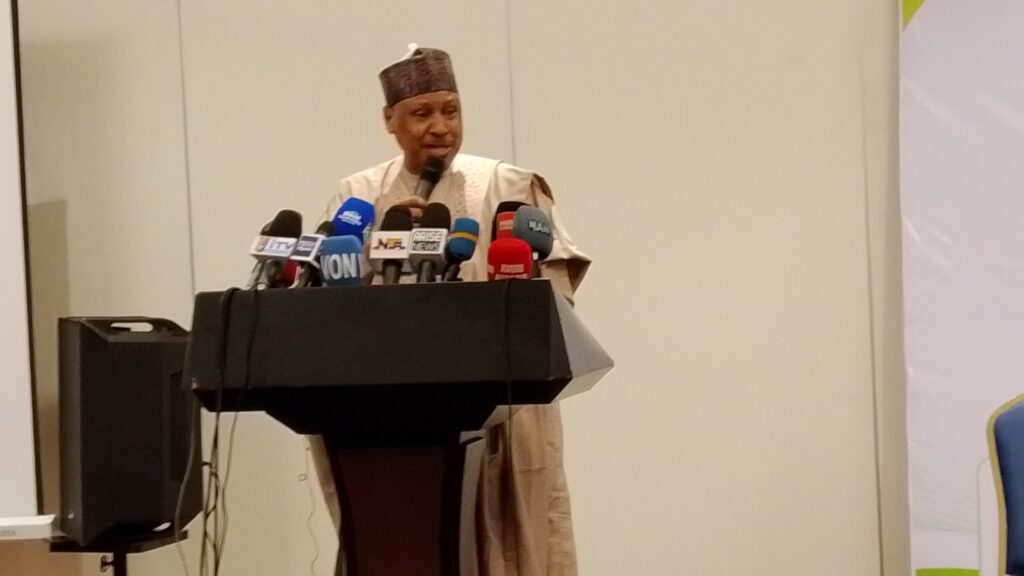
Idris made the remarks at the opening of the two-day National Security Summit jointly organised by the Nigeria Union of Journalists (NUJ) and the DSS in Abuja.
The minister said he was encouraged by the disclosure made by the NUJ National President, Alhassan Yahya, that the union had not recorded any case of arrest or imprisonment of Nigerian journalists by the DSS in approximately 18 months.
“I am particularly happy to hear from no other person than the President of the NUJ himself that for the first time in about one and a half years, there has not been a single incident where the Department of State Services arrested or imprisoned any member of the Nigerian media,” Idris said.
Describing the development as a significant milestone in media-security relations, the minister urged other security agencies to emulate the DSS and work towards ensuring that journalists are able to carry out their constitutional responsibilities without intimidation or unlawful detention.
“I hope that by the end of this year, we will hear that no media practitioner has been arrested or detained by any security agency. That is very important for our democracy,” he stated.
The minister attributed the progress to growing collaboration and mutual understanding between the media and security institutions, noting that complaints against security agencies from media organisations had significantly reduced in recent months.
He also reaffirmed President Bola Ahmed Tinubu’s commitment to democratic principles, press freedom, and the welfare of journalists across the country.
According to the Minister, the President has repeatedly emphasized the need to uphold democratic values and create an environment where the media can operate freely while discharging its responsibilities professionally.
"President Bola Ahmed Tinubu has assured media practitioners of better days ahead. There is ongoing work to uplift and enhance the welfare of all practicing journalists in Nigeria, and very soon Nigerians will hear good news from Mr. President,” Idris said.
Speaking on the summit theme, “Media and Security Agencies as Partners in Nation Building,” Idris stressed that the relationship between journalists and security agencies must be anchored on mutual respect, professionalism, trust, and appreciation of their complementary roles.
He noted that while security agencies are charged with protecting lives, property, and national sovereignty, the media serves as the watchdog of society and a bridge between government and citizens.
"Both institutions are critical to nation-building. There may be disagreements from time to time, but we must see ourselves as partners committed to strengthening our democracy and moving Nigeria forward,” he said.
The minister observed that security challenges across the world have become increasingly complex, ranging from terrorism and violent extremism to cybercrime, misinformation, organized crime, and separatist agitations.
According to him, Nigeria’s security environment requires collective action, strategic communication, responsible journalism, and stronger collaboration among all stakeholders.
While reaffirming government support for press freedom, Idris cautioned journalists against reporting in ways that could inadvertently amplify the activities of terrorists and criminal groups.
He emphasized that freedom of the press and social responsibility must go hand in hand.
“You cannot take press freedom and leave responsibility aside. The two are not mutually exclusive. They must work together if we are to sustain a vibrant democracy,” he said.
The minister urged media organizations to exercise editorial judgment when reporting security issues, arguing that excessive publicity for terrorists and criminal groups often serves their propaganda objectives.
“The best reporter and the best editor are those who know what not to report in the interest of nation-building. Nobody is calling for censorship, but we must remember that we have a country to protect,” he added.
He also called for greater recognition of the sacrifices made daily by security personnel working to combat terrorism, banditry, kidnapping, and other criminal activities across the country.
Idris said the Tinubu administration remains committed to tackling insecurity through both military operations and socio-economic interventions aimed at addressing the root causes of violence.
He highlighted ongoing investments in youth empowerment, infrastructure, education, and social intervention programmes designed to create opportunities and reduce vulnerability among young Nigerians.
The minister cited the Nigerian Education Loan Fund (NELFund) as one of the administration’s flagship initiatives, noting that more than 1.3 million Nigerians have benefited from the programme, enabling students to pursue higher education regardless of their financial background.
“President Tinubu’s vision is that no qualified Nigerian student should be denied education because of lack of funds,” he said.
Earlier, NUJ National President Alhassan Yahya described the summit as a historic platform aimed at strengthening cooperation between journalists and security institutions in addressing Nigeria’s growing security challenges.
He said the summit was part of his commitment, upon assuming office in 2024, to create opportunities for engagement between media practitioners and key national institutions.
Yahya noted that Nigeria continues to grapple with terrorism, banditry, kidnapping, cybercrime, misinformation, violent extremism, and separatist agitations, making stronger partnerships between the media and security agencies imperative.
The theme of this summit reflects our shared understanding that national security is not the responsibility of security agencies alone. It requires the collective efforts of government institutions, the media, civil society, and citizens working together in the national interest,” he said.
The NUJ president stressed that journalists have a constitutional obligation to provide accurate, balanced, and responsible reporting while contributing positively to national cohesion and democratic development.
He expressed optimism that discussions and recommendations from the summit would deepen trust, improve understanding, and strengthen cooperation between media professionals and security agencies.
The summit featured participants from the media, security institutions, academia, civil society organizations, and government agencies, with discussions focused on enhancing collaboration in addressing Nigeria’s security and development challenges.(Africa News Nation)