Journalists in Ondo State have been urged to strengthen investigative reporting, verify political claims and prioritise issues affecting citizens as the country prepares for the 2027 general elections.
Media professionals were also advised to guard against misinformation, politically motivated reporting and the misuse of artificial intelligence, while maintaining professional independence and personal safety throughout the electoral process.
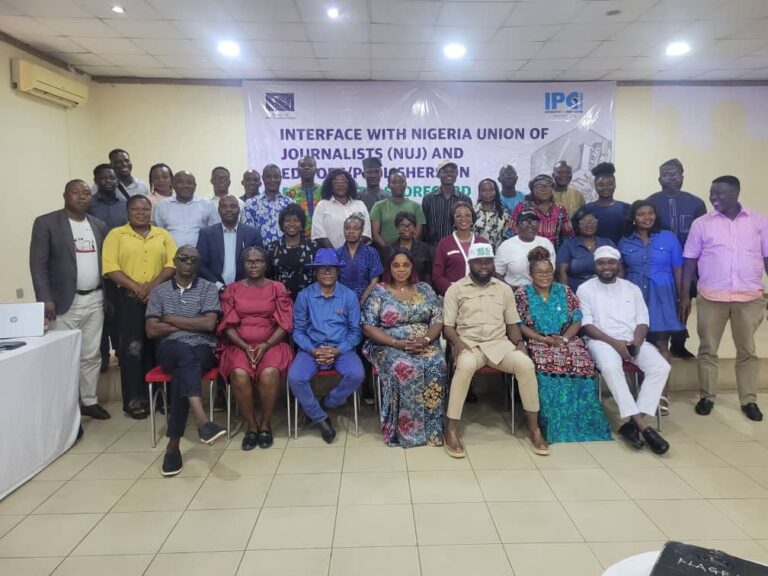
The recommendations formed part of discussions at an interface organised by the International Press Centre (IPC) for the Nigeria Union of Journalists (NUJ), editors and publishers in Akure on Thursday.
The engagement, themed around professional and democratic accountability in journalism, was held under Component 4 – Support to Media – of the European Union Support to Democratic Governance in Nigeria (EU-SDGN III) Programme.
Speaking on behalf of the IPC Executive Director, Mr. Lanre Arogundade, the organisation’s Programme Officer, Mrs. Stella Nwofia, said election reporting must extend beyond political campaigns, rallies and candidates to examine the expectations, concerns and priorities of the electorate.
She noted that voters needed credible, balanced and inclusive information to make informed decisions, stressing that the media had a responsibility to scrutinise political promises and hold public officials and candidates accountable.
Nwofia warned that sensationalism, unverified allegations, inflammatory rhetoric and the circulation of false information could undermine public trust in the electoral process and deepen existing divisions.
She therefore urged journalists to adopt rigorous verification practices, exercise fairness in their coverage and approach sensitive political issues with due regard for their potential impact on peace and stability.
The IPC programme officer also called for broader representation in electoral reporting, urging newsrooms to give adequate attention to concerns surrounding the economy, education, healthcare, security, employment and infrastructure.
She said the perspectives of women, young people, persons with disabilities and other underrepresented groups must feature prominently in election coverage to ensure that public discourse reflects the interests of the wider population.
On the growing influence of digital media, Nwofia observed that technology had expanded opportunities for public participation but had also accelerated the spread of manipulated content, misinformation and hate speech.
She maintained that fact-checking should be an integral part of newsroom operations, particularly during elections, when false claims could mislead voters and heighten political tensions.
Nwofia further highlighted the importance of journalists’ safety and professional independence, disclosing that IPC had developed an application, WorkFlow, to assist journalists in reporting and responding to harassment by security agencies.
The Chairman of the Ondo State Council of the NUJ, Mr. Leke Adegbite, described the engagement as timely, commending IPC for its sustained efforts to improve journalists’ professional capacity.
Adegbite expressed concern about the growing threat of disinformation ahead of the 2027 elections, warning that false reports circulated by unprofessional actors could mislead the public and create unnecessary tension.
He referred to the circulation of purported lists of governorship candidates allegedly disqualified by the Independent National Electoral Commission (INEC), which were also amplified by some mainstream and international media platforms, as an indication of the challenges ahead.
He urged journalists to resist political bias, verify information before publication and take digital journalism and artificial intelligence seriously as the media landscape continues to evolve.
Experts highlight technology, verification and newsroom ethics
The risks and opportunities presented by emerging technologies featured prominently in the training sessions.
Daniel Dare Dabo, who spoke on leveraging technology for credible election coverage, examined the implications of artificial intelligence and digital journalism for news gathering and dissemination.
He cautioned against deepfakes, automated accounts, privacy breaches and the pressure to break news before competitors, reminding journalists that speed should never take precedence over accuracy.
In a separate session, Olusola Oludiran, an NDR/IPC fact-checker, explained the fact-checking process and examined the different forms of information disorder, including misinformation, disinformation and malinformation.
Participants were introduced to verification tools such as reverse image search, InVID, Hive Moderation and Google Lens to help establish the authenticity of photographs, videos and other digital materials before publication.
Also speaking, Mr. Adegbenro Adebayo, a senior journalist and Director of Corporate Communications at the Federal University of Technology, Akure, advocated precision journalism anchored on neutrality, fairness, balance, objectivity and newsroom discipline.
Adebayo warned against planted stories and urged journalists to distinguish clearly between factual news reports, opinion pieces and editorials.
He further advised reporters covering the 2027 elections to take their safety seriously before, during and after the polls. He cautioned against working alone, encouraged thorough investigations into electoral allegations and recommended vox pops as a means of capturing the views and experiences of ordinary citizens.
He also urged journalists to remain calm and exercise professionalism when interacting with security personnel in the course of their assignments.
The IPC and the Ondo NUJ leadership acknowledged the European Union's financial support for the programme.
The organisers stressed that the real measure of the training's success would be seen in the quality of subsequent election coverage, the claims journalists independently verify, the concerns of citizens they bring to public attention and their commitment to professional standards in the months leading to the 2027 general elections.