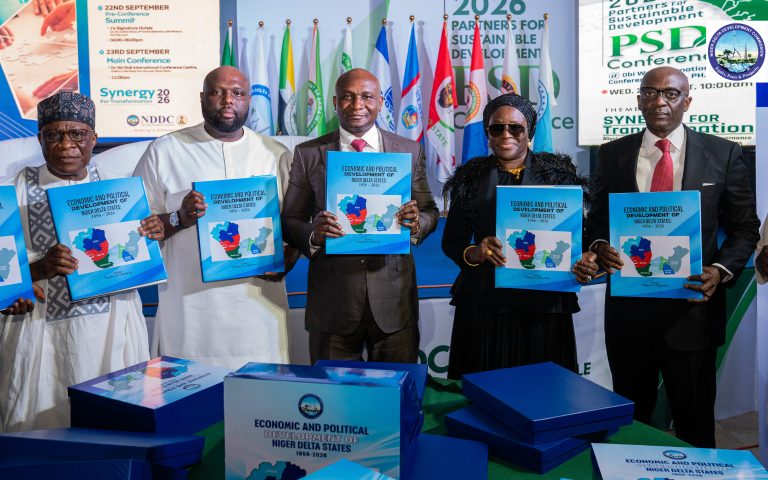
The Federal Government has moved to deepen coordinated regional development across Nigeria, with the Minister of Regional Development, Engr. Abubakar Momoh, urging all Regional Development Commissions to emulate the Niger Delta Development Commission (NDDC) by producing comprehensive master plans that can be harmonised into a single national development framework.
Speaking at the 2026 NDDC Partners for Sustainable Development (PSD) Conference in Port Harcourt, Rivers State, Momoh said the Ministry was working on a policy framework that would align regional development initiatives nationwide and ensure that each commission derives its operational agenda from a harmonised master plan.
He described the NDDC’s initiative as a model for other regional commissions, noting that coordinated planning was essential to addressing Nigeria’s development challenges.
According to him, no single institution can tackle the complex socio-economic issues confronting the Niger Delta, stressing that the region’s future depends on how governments, communities, development partners and the private sector plan, invest and act collectively.
The minister said President Bola Tinubu’s administration remained committed to programmes that expand economic opportunities, strengthen livelihoods, protect vulnerable communities and deliver long-term prosperity.
He challenged participants at the conference to interrogate existing practices, identify gaps and build stronger partnerships capable of accelerating sustainable development.
Also speaking, Imo State Governor Hope Uzodinma, represented by his deputy, Mrs Chinyere Ekomaru, called for stronger collaboration between the governors of the nine oil-producing states and the NDDC to drive sustainable growth across the Niger Delta.
She reaffirmed the state’s commitment to supporting the Federal Government’s Renewed Hope Agenda and initiatives aimed at improving the lives of people in the region.
NDDC Managing Director, Dr Samuel Ogbuku, said stakeholder engagement had become central to the Commission’s development strategy, insisting that communities must be involved from the planning stage if projects are to achieve lasting impact.
He explained that the Commission had institutionalised reforms designed to strengthen public trust, including a comprehensive review of its processes by global consulting firm KPMG to reinforce accountability, transparency and performance measurement.
According to Ogbuku, the reforms have produced a more robust corporate governance structure backed by measurable Key Performance Indicators (KPIs), while engagement with stakeholders is intended to prevent government agencies from working at cross-purposes and instead leverage collective strengths.
He also announced that the 1.2-kilometre Kaa-Ataba Bridge linking Khana and Andoni Local Government Areas of Rivers State would be named after President Bola Tinubu.
Chairman of the NDDC Governing Board, Mr Chiedu Ebie, said the Commission had adopted a new Standard Operating Procedure (SOP) alongside Governance Advisory Policies approved by the Board to serve as the Commission’s official rule book guiding all operational processes.
He said the new governance framework would institutionalise discipline, consistency and accountability across the Commission’s activities.
On the legislative front, Chairman of the Senate Committee on NDDC, Senator Asuquo Ekpenyong, assured stakeholders that the National Assembly would sustain robust oversight to promote transparency, efficiency and the timely delivery of development projects throughout the Niger Delta.(The Atlantic Bell)