By: ARCHIBONG ESUENE
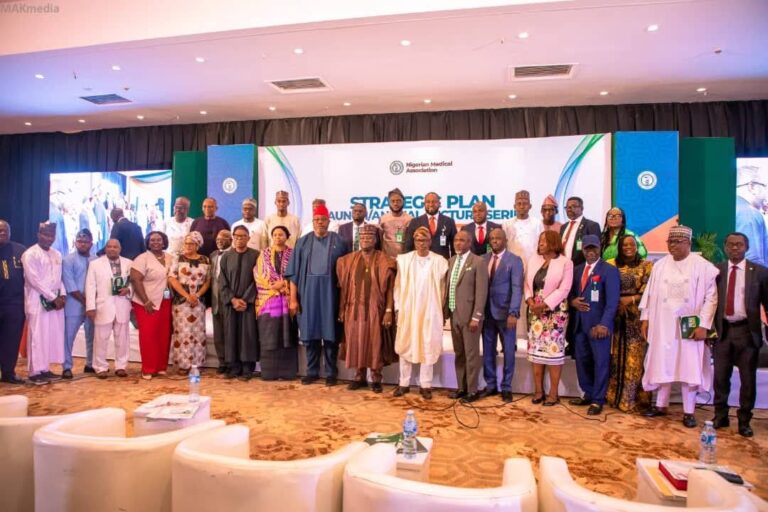
The Nigerian Medical Association (NMA) has launched its 2026–2030 Strategic Plan and revived its Annual Lecture Series, with top government officials and health sector stakeholders calling for stronger implementation, continuity of policies, and decisive reforms to reposition the association as a catalyst for national health transformation.
The event, held at the Ladi Kwali Conference Centre, Abuja Continental Hotel, attracted senior government officials, medical professionals, policymakers, and leaders of the association.
Chairman of the occasion and Minister of State for Health, Dr. Isiak Adekunle Salako, congratulated the NMA for institutionalising the Annual Lecture Series and unveiling a long-term strategic roadmap, describing planning as critical to sustainable development.
“Those who fail to plan, plan to fail,” the minister said, while commending the current NMA leadership for what he described as foresight, professionalism, and continuity, qualities he urged incoming leaders to sustain.
Salako said the health sector occupies a central position in President Bola Tinubu’s Renewed Hope Agenda, quoting the President as saying that “the health of all Nigerians is a matter of urgent right.” He disclosed that the Federal Government is strengthening the primary healthcare system and improving health security to ensure timely responses to infectious disease outbreaks.
The minister also expressed appreciation to Nigerian health practitioners who have chosen to remain in the country to serve, despite the growing trend of medical professionals migrating abroad.
Earlier, a former President of the NMA and immediate past Vice Chancellor of the Federal University of Health Sciences, Otukpo, Prof. I.A.O. Ujah, identified lack of continuity in policies and projects as a major setback to development in Nigeria’s health sector.
Ujah disclosed that although the NMA was founded in 1952, it had no annual lecture series until his tenure, when he initiated it, regretting that he failed to entrench it in the association’s constitution. He expressed optimism that the revived lecture series would now be institutionalised.
Delivering the keynote address, Permanent Secretary, General Services Office, Office of the Secretary to the Government of the Federation (SGF), Dr. Ibrahim Abubakar Kana, described the NMA as not just a professional body but a national institution with the credibility and moral authority to drive health sector transformation.
While commending the NMA leadership for producing what he referred to as an “apt and timely” strategic plan, Kana cautioned that “plans do not save lives; implementation does.”
He noted that Nigeria’s health system reflects both resilience and vulnerability, citing poor remuneration, weak financing, and workforce burnout as major drivers of the ‘japa’ syndrome. He also disclosed that Nigeria accounts for a disproportionately high share of global maternal deaths, challenging the NMA to take a leadership role in reversing the trend.
Kana outlined key pillars for transformation, including workforce empowerment and welfare advocacy, evidence-based policy engagement, strategic partnerships, strengthening primary healthcare, and sustainable health financing through expanded health insurance coverage.
He urged the association to shift from episodic advocacy to governance-oriented leadership, recommending internal reforms, proactive engagement by the NMA National Executive Council, and stronger collaboration with government to revitalise primary healthcare centres nationwide.