By: Raymond Enoch
As West Africa intensifies efforts to strengthen regional integration, the Economic Community of West African States (ECOWAS) is advancing migration governance and the free movement of people as critical pillars of economic growth, regional stability and shared prosperity. By promoting the movement of citizens, goods and services across national borders, the regional institution seeks to dismantle barriers to trade, expand employment opportunities and enable close 400 millions of West Africans to benefit from the opportunities of a more integrated Community.
However, achieving the full promise of regional integration requires more than guaranteeing the right to cross borders. It demands effective migration governance, coordinated border management, protection of migrants’ rights, expanded labour mobility and strategic responses to climate-induced displacement, irregular migration, and the challenges of return and reintegration. Against this backdrop, the ECOWAS Commission is deepening its collaboration with the International Organization for Migration (IOM) to strengthen regional migration frameworks and translate existing commitments into tangible benefits for citizens across West Africa.
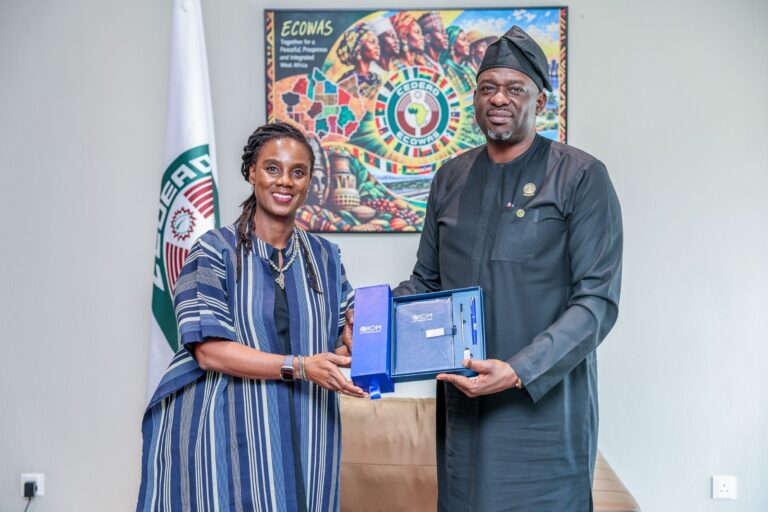
The renewed commitment emerged during a working visit by the IOM Regional Director for West and Central Africa, Mrs. Sylvia Ekra, to the ECOWAS Commission headquarters in Abuja from October 26 to 28, 2026.
During the visit, Ekra held strategic engagements with the Vice-President of the ECOWAS Commission, H.E. Anthony Ogunjimi, alongside other senior officials, to review the partnership between the two institutions and identify practical ways of aligning their cooperation with the evolving migration priorities of ECOWAS Member States.
The discussions focused on deepening collaboration in five critical areas: free movement, labour mobility, climate-induced mobility, return and reintegration, and migration governance.
The engagements reflect a shared recognition that migration, when properly managed, can serve as a powerful instrument for regional development, economic diversification, human security and social advancement.
For ECOWAS, whose regional integration agenda places considerable emphasis on the movement of people and the development of a common regional space, stronger cooperation with IOM offers an opportunity to reinforce institutional capacity, improve policy coordination and support Member States in addressing increasingly complex migration challenges.
The meeting with Ogunjimi formed part of a broader series of high-level consultations involving key leadership of the ECOWAS Commission.
Ekra also paid courtesy visits to the Commissioner for Economic Affairs and Agriculture, Mr. Dehpue Zuo, and the Commissioner for Human Development and Social Affairs, Prof. Nassirou Bako-Arifari.
These engagements were complemented by technical working sessions with various directorates of the Commission, providing an opportunity for both institutions to assess existing areas of cooperation, identify gaps and explore practical approaches to strengthening their partnership.
A major consideration was how regional migration initiatives could respond more effectively to the needs and priorities of Member States while ensuring that the benefits of migration are better harnessed for economic development and the welfare of citizens.
The renewed focus on free movement and labour mobility underscores the importance of ensuring that West Africans can access legitimate opportunities across the region while benefiting from appropriate legal safeguards and institutional support.
ECOWAS has long recognised free movement as a cornerstone of its integration agenda. However, the effective implementation of regional commitments requires sustained cooperation among Member States, particularly in addressing administrative bottlenecks, improving border procedures and strengthening the protection of migrants.
Deeper collaboration with IOM could support efforts to improve migration management systems, promote regular migration pathways and strengthen the capacity of national institutions to respond to emerging challenges.
Labour mobility also presents opportunities to connect workers with employment opportunities across the region, facilitate the movement of skills and support economic sectors facing labour shortages.
As West African economies pursue greater regional trade and investment, effective migration policies will remain essential to ensuring that citizens can participate meaningfully in the opportunities created by integration.
The inclusion of climate-induced mobility among the priority areas highlights another increasingly important dimension of regional migration governance.
Climate-related pressures, including flooding, drought, environmental degradation and declining agricultural productivity, can undermine livelihoods and compel communities to relocate in search of safety and economic opportunities.
For countries whose populations depend significantly on agriculture and other climate-sensitive livelihoods, these pressures can have far-reaching implications for food security, employment, displacement and social stability.
Coordinated regional approaches are therefore essential to strengthening preparedness, improving migration-related data and supporting communities affected by environmental changes.
Through closer cooperation, ECOWAS and IOM can explore approaches that integrate migration considerations into broader development, climate adaptation and human security policies.
The discussions on return and reintegration also point to the importance of ensuring that migrants returning to their countries of origin receive appropriate support to rebuild their lives and livelihoods.
Effective reintegration programmes can help reduce vulnerability, promote economic recovery and enable returning migrants to contribute to their communities.
Beyond reviewing their existing partnership, the engagements provided an opportunity for ECOWAS and IOM to consider how their collaboration could become more responsive to the priorities of Member States.
The emphasis on tangible benefits for Community citizens places implementation at the centre of the renewed cooperation, with the potential to strengthen the connection between regional policy commitments and the everyday experiences of people crossing borders in search of education, employment, trade and other opportunities.
For the two institutions, closer coordination across political, economic, social and technical levels will be important in addressing the interconnected nature of migration challenges.
The participation of commissioners responsible for economic affairs, agriculture, human development and social affairs further reflects the cross-cutting character of migration, which extends beyond border management to encompass employment, social protection, economic development and regional cooperation.
As ECOWAS continues to pursue a more integrated and prosperous West Africa, strengthened engagement with IOM offers an avenue for advancing a coordinated regional approach that recognises migration not merely as a challenge to be managed, but also as a development opportunity to be harnessed.
The Abuja engagements therefore reinforce the importance of sustained institutional partnerships in advancing free movement, improving migration governance and ensuring that regional integration delivers meaningful outcomes for citizens throughout the Community.
Ultimately, the renewed commitment by ECOWAS and IOM places migration governance firmly within the broader regional agenda of economic integration, human security and sustainable development, with effective implementation remaining central to translating shared priorities into measurable progress.
(Paradigm News)