By Amos Aar
The Benue State Government and humanitarian partners have called for a robust collaboration to address the challenges facing internally displaced persons (IDPs) and support their transition from emergency assistance to sustainable recovery as the International Organization for Migration (IOM) Nigeria marked its 25th anniversary.
The call was made on Thursday in Makurdi during the anniversary celebration, which highlighted IOM’s contributions to humanitarian assistance, displacement management, community resilience and the protection of vulnerable populations across the state. The event, held at the Fr. Hyacinth Alia Conference Hall, gathered government officials, United Nations agencies, development partners and representatives of displaced communities
In a goodwill message delivered on behalf of Governor Hyacinth Alia, the Secretary to the State Government, Deborah Serumun Aber, commended IOM for supporting displaced persons and strengthening humanitarian interventions in Benue.
Aber, represented by Hon. Imande Alexander, Senior Special Assistant to the Governor on Public Policy, said the state government valued partnerships that addressed immediate needs while creating opportunities for rehabilitation, resettlement and social reintegration. She also welcomed IOM’s tree-planting exercise at the Yelewata Resettlement Housing Site, describing it as a symbol of renewal, resilience and the collective determination to rebuild affected communities.
The Acting Head of IOM’s Benue Sub-Office, Francis Ukonu, said the organisation had worked with the state government and other partners to assist vulnerable populations affected by displacement, insecurity, flooding and climate-related emergencies since 2018. He pointed out interventions including shelter, protection, camp coordination and management, water, sanitation and hygiene, livelihood support, flood response and displacement tracking among the organisation’s contributions to humanitarian efforts in the state.
Ukonu identified Daudu, Abagena, Yelewata, Ortese, Gbajimba, Ichwa, Uikpam, Agagbe and Naka among the communities where humanitarian interventions had made a difference, alongside the Mbayongo Mega Camp and other displacement locations. He also highlighted the Fr. Hyacinth Alia Conference Hall as a symbol of cooperation between IOM and the state government, noting that the facility’s completion reflected a shared commitment to strengthening humanitarian coordination and emergency response.
However, the IOM official cautioned that significant needs remained in communities across Agatu, Apa, Ohimini, Otukpo, Kwande, Ukum, Logo and Katsina-Ala, where families continued to face displacement, livelihood difficulties and limited access to essential services.
He called for stronger partnerships and more inclusive interventions, urging stakeholders to ensure that humanitarian support reached underserved communities and helped affected families rebuild their lives with dignity.
In her virtual address, IOM Nigeria’s Chief of Mission, Sharon Dimanche, congratulated the Benue State Government, residents and humanitarian partners on the milestone, describing the state as an important part of the organisation’s humanitarian journey. She said displaced people deserved more than temporary assistance, stressing the need to help families rebuild their lives, regain independence and become part of thriving communities. Dimanche who was not physically present but spoke virtually during the event also commended IOM personnel working on the ground for their dedication to supporting affected populations.
Also speaking, the Executive Secretary of the Benue State Emergency Management Agency (BSEMA), Sir James Aondoakaa Iorpuu, also commended IOM for its interventions in the state, including support for displaced families, shelter improvements, water facilities, livelihood recovery and humanitarian coordination. He highlighted the importance of biometric enumeration of displaced persons across the state’s 17 affected local government areas in improving beneficiary identification, data management, planning and accountability. Iorpuu further acknowledged the contributions of IOM’s pioneer head of sub-office in Benue, Mediatrice Barengayabo, to strengthening humanitarian partnerships.
Representing the United Nations agencies in Benue, the Head of the UNHCR Benue Field Office, Evelyn Happy Katono, commended IOM’s collaboration with government institutions and humanitarian organisations. She said the organisation’s participation in the UN’s coordination framework had strengthened joint planning, information-sharing and coordinated responses, adding that its partnership with UNHCR had improved collective efforts to protect displaced populations, promote durable solutions and build community resilience.
The Director-General of the Benue State Sustainable Development Goals Office, Sir John Akuse, called for greater Nigerian ownership of humanitarian assistance, arguing that the country must progressively strengthen its capacity to support citizens affected by displacement. He urged local authorities and communities to recognise displaced persons as their own people and take greater responsibility for their welfare.
Akuse also said relevant humanitarian assessments and action plans should help local institutions build the capacity needed to sustain interventions.
In her goodwill message, the Commissioner for Education and Knowledge Management, Dr Margaret Ijaguwa Adamu, represented by the ministry’s Deputy Director of Collaboration and Partnership, Dorothy Ganyam, stressed the need to protect the education of children affected by displacement. She said every child, regardless of their circumstances, deserved access to quality, inclusive and uninterrupted learning, adding that collaboration with IOM and other development partners was essential to improving learning environments and ensuring displacement did not become a permanent barrier to educational attainment.
On his part, the Director-General of the Bureau for International Cooperation and Development, Mr Angelo Viashima, represented by Saasongu Akome, said the agency provided an additional platform for strategic cooperation among development partners under Governor Alia’s administration.
Meanwhile, an IDP representative, Zaki Kumaga Jor, thanked IOM and Iorpuu for supporting displaced families, particularly those from Yelewata, where he said humanitarian interventions had helped people cope with the consequences of the attack on their community.
Jor said the assistance had been crucial to the survival of displaced families, expressing appreciation to the organisations and officials who continued to support them in displacement camps.
There was a unanimous renewed call for stronger partnerships, improved local capacity and sustained interventions to ensure that displaced persons could move beyond emergency relief towards safe resettlement, self-reliance and lasting recovery.
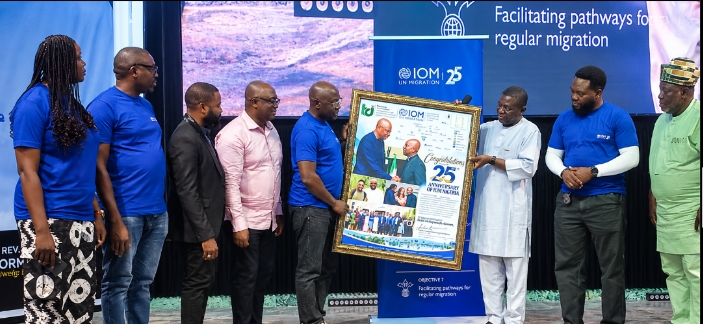
Highlights of the event included the cutting of the anniversary cake and the presentation of awards between the Benue State Government and IOM in recognition of their humanitarian partnership and contributions.(Sky news link)