By: Ali Rabiu Ali
The Nigeria Union of Journalists (NUJ), Jigawa State Council, in collaboration with the Jigawa State Government, on Saturday held a Ramadan lecture aimed at addressing the growing menace of fake news and hate journalism in society.
The lecture, which took place at the NUJ Secretariat in Dutse, was organised in partnership with the state government through the Office of the Secretary to the State Government (SSG).
Speaking at the event, the NUJ Chairman, Jigawa State Council, Comrade Ismail Ibrahim Dutse, said the programme was conceived to sensitize journalists and the general public on the dangers posed by misinformation and unethical reporting.
He explained that the union received full backing from the state government after presenting the proposal for the lecture.
“Alhamdulillah, this lecture was organized by the NUJ in collaboration with JIGASARIGAMA through the SSG’s office. When we presented the idea, the government gave us full support because of the importance of the topic,” he said.
According to him, after approaching the Permanent Secretary representing the SSG, he was directed to meet with senior government officials who subsequently approved and supported the initiative.
Comrade Dutse noted that the primary objective of the lecture was to promote ethical journalism and remind practitioners of their noble responsibilities in society.
He further disclosed that when the union proposed names of Islamic scholars to deliver the lecture, one of them, Abba Kersani, advised that the theme should be broadened to benefit not only journalists but the wider public.
“We were advised to widen the scope of the lecture so that it will not only address journalists but also educate the general public on the consequences of spreading unverified information,” he added.
On disciplinary measures for erring journalists, the NUJ chairman clarified that although the union’s constitution provides sanctions for unethical conduct, the council decided to prioritize awareness and reorientation.
“It is not our intention to immediately enforce punitive measures. The provisions are there in our constitution, but we believe this is a period for awareness and reorientation. If we can educate our members on the dangers of hate journalism, that will go a long way in addressing the problem,” he explained.
In his remarks, the Chief Press Secretary to the Jigawa State Governor, Alhaji Hamisu Muhammad Gumel, who represented the state government, reiterated the government’s commitment to supporting journalists in the discharge of their duties.
He stated that the government recognizes the vital role of the media in information dissemination and expresses concern over the harmful effects of fake news if left unchecked.
“The government is worried about the consequences of fake news if allowed to spread unchecked. That is why we encourage the NUJ to strengthen its internal mechanisms to ensure responsible reporting,” he said.
While acknowledging the challenges posed by the social media era, he noted that controlling the flow of information online remains difficult but stressed that existing laws require individuals to be mindful of what they publish or share.
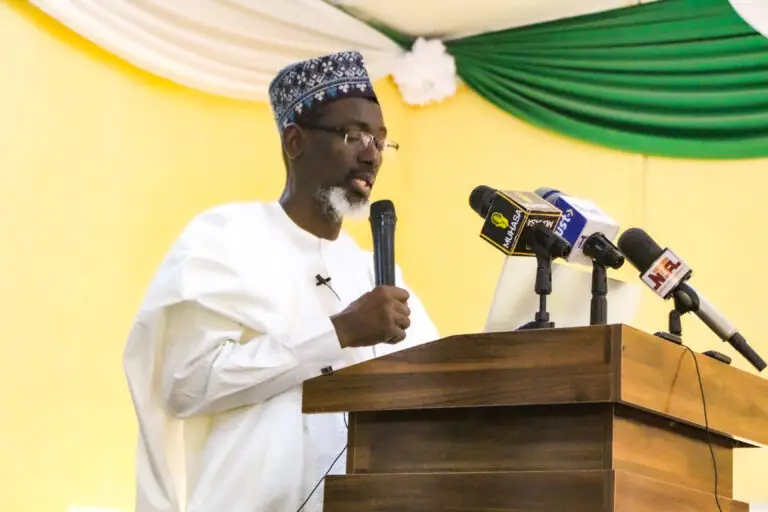
Delivering the main lecture, Associate Professor Sheikh Abubakar Muhammad Sani of Birnin Kudu examined the negative impacts of fake news and the expected role of journalists in combating misinformation.
He observed that fake news has become widespread, affecting political, economic and religious spheres of life, and called on religious leaders to play a more active role in addressing the menace.
“Fake news has penetrated all aspects of our lives. It affects politics, economic activities, and even religious harmony. There is a need for religious leaders to play their role in guiding society,” he said.
The scholar emphasized that in a plural society comprising Muslims and non-Muslims, adherence to religious teachings particularly on justice, honesty and verification of information remains crucial in curbing misinformation.
He strongly advised journalists and members of the public to verify any information before sharing it.
“Any news item that comes your way should be verified as much as possible before dissemination. Verification is key to preventing the negative impact of fake news in society,” he stressed.
The lecture attracted journalists, government officials, religious leaders and members of the public, who collectively underscored the need for sustained collaboration to promote responsible journalism and safeguard societal harmony.