A Mass Communication lecturer at the Enugu State University of Science and Technology (ESUT), Dr Maxwell Menkiti Ngene, has called on Nigerian journalists and media organisations to uphold professional ethics, editorial independence and accountability to restore public confidence ahead of the 2027 general elections.
Ngene, the Head of the Department of Mass Communication, ESUT, said credible journalism was essential to democratic development, warning that misinformation, political interference, sensationalism and unethical practices could undermine citizens’ confidence in democratic institutions.
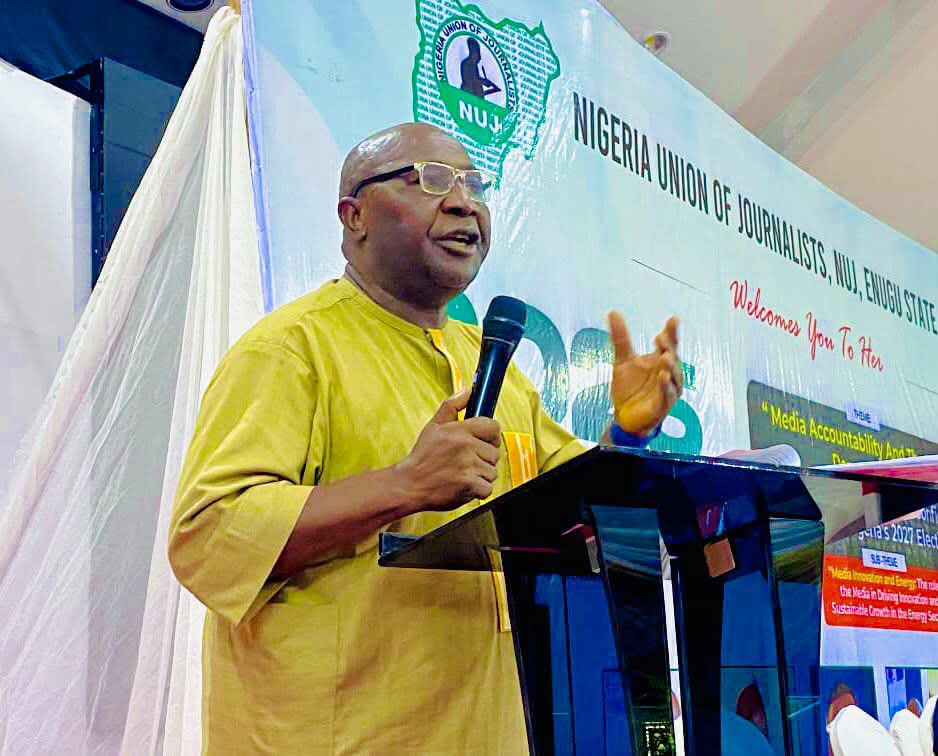
He made the call on Thursday while delivering the keynote address at the 2026 Press Week Grand Finale of the Nigeria Union of Journalists (NUJ), Enugu State Council.
Speaking on the theme, “Media Accountability and the Future of Democratic Trust: Confronting the Crisis of Confidence Ahead of Nigeria’s 2027 Elections,” the university don said democracy depended not only on periodic elections but also on citizens’ access to accurate and reliable information.
He noted that the media played a critical role in informing citizens about government activities, political developments, public policies and electoral processes, stressing that public confidence in journalism was necessary for informed electoral choices.
According to him, citizens require credible information about candidates, political parties and their manifestoes before elections, as well as accurate reports on voting procedures, electoral incidents, results and post-election developments.
He, however, stressed that the media alone could not guarantee credible elections, noting that the responsibility also rested on the Independent National Electoral Commission (INEC), political parties, candidates, security agencies, the judiciary and other stakeholders.
Ngene identified political interference, perceived media partisanship, sensational reporting and brown-envelope journalism as some of the challenges threatening the credibility of the Nigerian media.
He condemned the practice of accepting money or other gratification in exchange for favourable coverage or suppression of information, describing it as a violation of the ethical foundations of journalism.
The lecturer also called for improved welfare of media workers, arguing that poor remuneration, delayed salaries, inadequate reporting facilities and job insecurity could expose journalists to unethical practices.
He maintained that media accountability should not be imposed on journalists alone but should also extend to media owners and managers, who have a responsibility to provide conducive working conditions, necessary equipment and protection against political interference.
“The journalist is not only a professional responsible for informing society. The journalist is also a worker entitled to fair remuneration, safe working conditions, professional development and institutional protection,” he said.
Ngene further warned that emerging technologies, artificial intelligence and automation were changing newsroom operations, urging media organisations to embrace innovation without compromising workers’ welfare and professional standards.
He cited Section 22 of the 1999 Constitution, as amended, which mandates the mass media to hold government accountable to the people, and Section 39, which guarantees freedom of expression and the right to receive and impart information.
He explained that the constitutional provisions underscored the need to balance media freedom with professional responsibility, adding that accountability should not be used as an instrument of government control over editorial decisions.
On public confidence in the media, Ngene referenced the Reuters Institute for the Study of Journalism’s Digital News Report 2026, which recorded a 68 per cent overall news-trust score among surveyed online respondents in Nigeria, while 63 per cent said they sometimes or often avoided the news.
He said the findings demonstrated that news trust and news avoidance could coexist, adding that public confidence should be assessed through credible evidence rather than general assumptions.
The ESUT don also advocated stronger fact-checking mechanisms and collaboration between media organisations and independent verification agencies to combat misinformation.
He commended the Nigerian Guild of Editors (NGE) for encouraging newsrooms to establish dedicated fact-checking desks, describing the initiative as an important step towards strengthening accuracy and rebuilding public trust.
He urged journalists to apply consistent professional standards in reporting political actors, regardless of their political affiliations, and to distinguish facts from opinions while correcting errors whenever they occurred.
Ngene concluded that democratic trust could only be sustained through accuracy, fairness, transparency and accountability, stressing that media credibility would be particularly important as Nigeria prepares for the 2027 general elections.
(Freedom square news)