Pressure has continued to mount on the National Assembly to approve mandatory real time electronic transmission of results from polling units to IRev portal in the ongoing Electoral Amendment process before the parliament.
This is as senators are set to reconvene for an emergency plenary session today amid growing demands for the inclusion of mandatory electronic transmission of results in the amendment to the Electoral Act.
The upper chamber had adjourned plenary for two weeks last Wednesday after passing the Electoral Act amendment bill, to enable lawmakers engage heads of Ministries, Departments and Agencies (MDAs) in the defence of their 2026 budget proposals.
The notice of the emergency sitting was contained in a memo dated 8 February and circulated to senators. It was signed by the Clerk of the Senate, Emmanuel Odo.
In the memo, Mr Odo said he was acting on the directive of the Senate President, Godswill Akpabio.
The memo did not state the reason for the emergency plenary. However, there are strong indications that it is connected to the outrage over the Electoral Act amendment bill passed last Wednesday before the adjournment.
Although several provisions of the law were amended, public attention has focused mainly on one controversial clause: the rejection of mandatory electronic transmission of election results from polling units to the Independent National Electoral Commission’s (INEC) Result Viewing Portal (IREV).
Last week, the Senate passed the Electoral Act 2022 (Repeal and Reenactment) Amendment Bill, 2026 through third reading. A major point of contention in the amended bill is the removal of the phrase “real-time” in provisions dealing with the electronic transmission of election results, move critics say weakens safeguards against manipulation.
Although the Senate has since issued multiple clarifications, insisting that it did not reject electronic transmission outright, protesters argue that the absence of the words “real-time electronic transmission” creates room for abuse and post-poll interference.
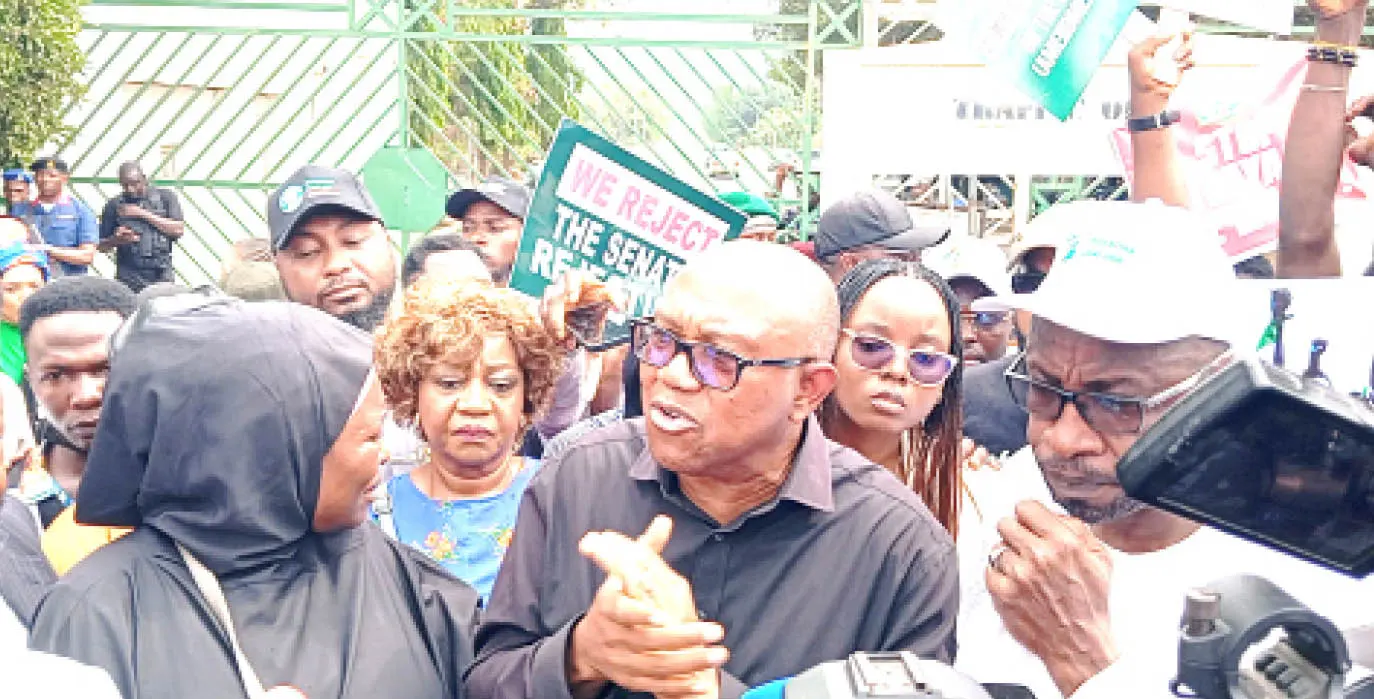
Yesterday, presidential candidate of the Labour Party in the 2023 election and one of the presidential hopefuls in 2027 election, Peter Obi alongside hundreds of demonstrators marched at the National Assembly Complex in Abuja to protest the Senate’s decision to remove “real-time” mandatory electronic transmission of election results from the Electoral Act Amendment Bill.
Obi joined the protest tagged: ‘Occupy the National Assembly,’ and organised by members of the Obidient Movement, National Opposition Movement and other pro-democracy activists.
They described the lawmakers’ action as a deliberate attempt to undermine electoral transparency ahead of the 2027 general elections.
Chanting solidarity songs and carrying placards with inscriptions such as “Our votes must count”, “No to electoral fraud”, “Akpabio, don’t destroy democracy”, “We reject the Senate rejection”, “Protect democracy now” and “Stop betrayal of the ballot”; the demonstrators marched from the Federal Secretariat towards the National Assembly.
However, they were prevented from gaining access to the complex by a heavy deployment of security personnel drawn from the Nigeria Police Force, the Nigerian Army and the Nigeria Security and Civil Defence Corps. The security operatives barricaded the main entrance, forcing the protesters to hold their demonstration outside the gates.
Addressing journalists at the protest ground, Obi condemned what he described as the steady erosion of democratic gains in the country, warning that credible elections remain the foundation of national stability and development.
“We must dismantle this criminality and prove that we are now a nation that shows light in Africa,” he said.
He declared that Nigerians would not entertain glitches in the next general election. Obi, who alleged that glitches marred the 2023 presidential election, insisted that the National Assembly must pass the proposed amendment to ensure transparency in the electoral process as Nigerians prepare for next general election.
“What we want is an electoral process that is transparent from the beginning to finish. Let’s have an amendment that will allow free and credible elections.
Allow the elections to go through the normal process. Whoever wins, we would accept. So, why are you bringing this confusion?” he said.
He said Nigeria, as the giant of Africa must rise up and live up to expectations in deploying technology to engender credible elections.
Also speaking, National Coordinator of the Obidient Movement Worldwide, Dr Yunusa Tanko, said the agitation would continue until the National Assembly restores real-time electronic transmission of results in the amended law.
He said, “If there is no electronic transmission of results, there will be no election. Our elections must be credible.”
Tanko said past elections had been marred by manual interference during result collation, a problem electronic transmission was meant to address following reforms introduced after the 2011 and 2015 elections.
Speaking during the protest, Ike Bishop Okoronkwo, a member of the National Opposition Movement, accused political actors of manipulating election results after votes are cast, insisting that electronic transmission would curb electoral fraud.
“People will come out on election day, after they vote; their votes are counted and recorded. Somebody will sit down somewhere and mutilate the results and make the process look like child’s play,” Okoronkwo said.
He argued that tampering with election results should attract the severest punishment, warning that failure to criminalise it amounted to complicity.
“It must be a capital offence. If they don’t make it a capital offence, then they are complicit,” he said.
Okoronkwo also directed his remarks at Senate President Godswill Akpabio, saying lawmakers must recognise that public opinion now carries greater weight.
“The will of the people is greater than the will of people in power. This is 2026, not 2022 or 2023. Things have changed. Young people are more aware, and the population has grown,” he said.
Dismissing claims that Nigeria lacks the capacity to transmit election results electronically, Okoronkwo described such arguments as “a blatant lie,” citing the widespread use of Point of Sale (POS) terminals across the country.
“There is no community in Nigeria that does not have a POS. If POS can work everywhere, why can’t we transmit results from all communities?” he asked, adding that emerging technologies could be deployed to support INEC’s infrastructure.
He warned that the group would sustain its protest if the Senate failed to act, though he stressed that the demonstrations would remain peaceful.
“If they don’t do the right thing, what they will see here, they will not believe it. We will shut down here peacefully. If it means sleeping here, we will sleep here until they do the right thing,” he said.
Okoronkwo added that the group was also opposed to the proposed tax law, insisting that Nigerians were yet to see clear guidelines on its implementation.
Also speaking at the protest, the Deputy National Publicity Secretary of the African Democratic Congress (ADC), Jackie Wayas, said the demonstration reflected a shared demand by Nigerians for credible elections.
“We’re here with fellow Nigerians, demanding one thing: real-time electronic transmission of results comes 2027,” she said.
Wayas urged the Senate to “do the right thing,” noting that the decision should not be left solely to the discretion of the Independent National Electoral Commission (INEC).
She expressed hope that the Senate would heed concerns already raised by some lawmakers but warned that protests would continue if the demand was ignored.
“It is our fundamental right to ask our leaders for real-time transmission of results. If it takes us one week or two weeks, we’ll come out every other day for this,” she said.
Popular activist, Randy-Peter Akah, who also spoke at the protest ground, accused the political class of betraying the ideals of democracy and vowed that demonstrators would return to the National Assembly until their demands are met.
"Tomorrow, we will be back here until the Senate does the right thing. The current administration supported the June 12 campaign. It was about free and fair elections,” he noted.
Invoking the spirit of the June 12, 1993 election, widely regarded as Nigeria’s freest and fairest poll, Peters questioned why elected leaders would resist reforms that guarantee credible outcomes.
He said, “Do we have Democrats who are afraid of losing elections? In 2027, our votes must count. The most important thing is that our votes must count. Tomorrow, they will meet us here again"…
(Daily Trust)